Agentic SEO
STRADIMARK | AI AGENCY | UNITED KINGDOM
Issue No.19
AGENTIC SEO · AI SEARCH · UK STRATEGY · 2026
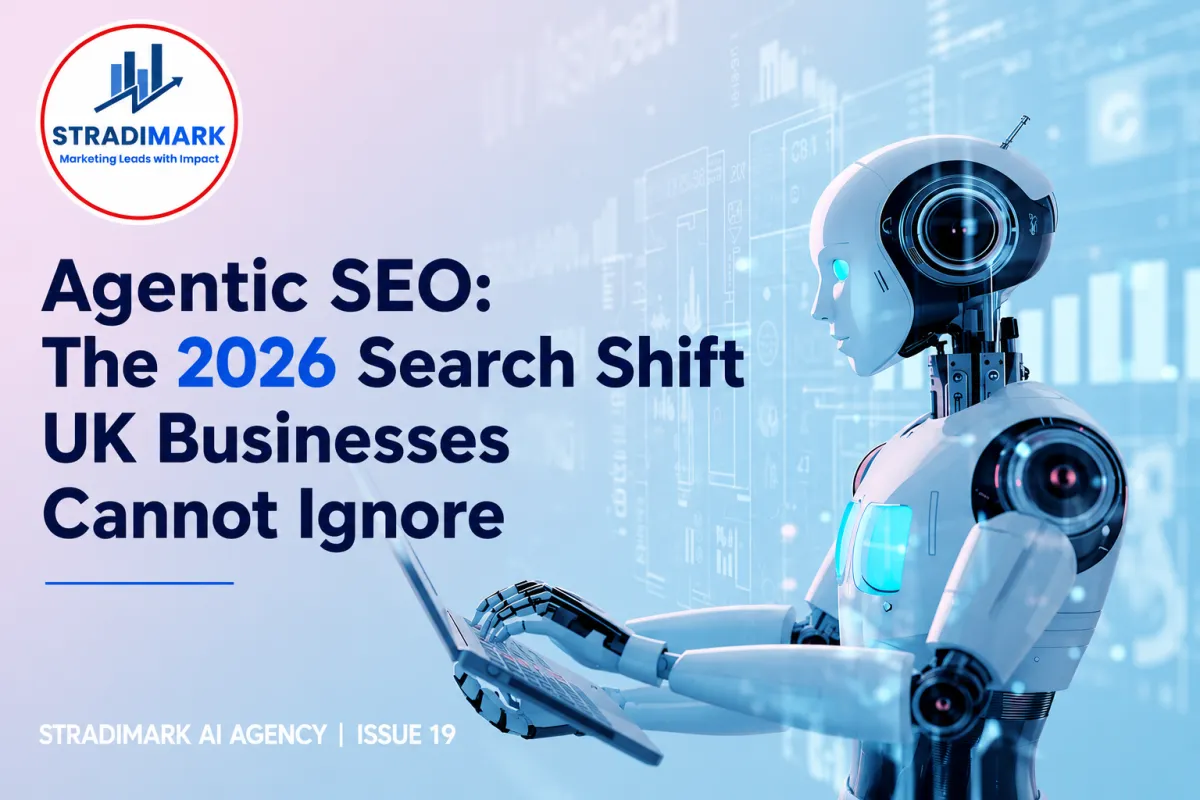
Agentic SEO: Why AI Agents Are Redefining Search Strategy in 2026
A professional briefing for UK business leaders on visibility, authority, and AI-driven discovery
By Stradimark
🔑 SEO: Agentic SEO 2026 · AI Agents Search UK · Answer Engine Optimisation · Google AI Overviews · AEO strategy UK · Generative Engine Optimisation
Search is moving beyond the traditional list of blue links. In 2026, AI agents are not just helping people find information; they are reading, comparing, summarising, recommending, and increasingly influencing decisions on their behalf.
For UK businesses, this creates a major strategic shift. Visibility now depends on whether your content can be understood, trusted, extracted, and cited by AI-powered search systems. That is the purpose of agentic SEO.
48%
of searches now show Google AI Overviews
3.2×
more AI citations for AEO-structured content
70%
more citations for pages with 120–180-word sections
1. What Agentic SEO Means
Agentic SEO is the practice of optimising content for AI agents that autonomously browse, evaluate, and synthesise information for users. These systems are embedded across tools such as ChatGPT, Perplexity, Google AI Overviews, and Microsoft Copilot. They do not simply index pages. They interpret them.
That means content must now serve two audiences at once: the human reader looking for insight, and the AI agent looking for clear, credible, structured information it can confidently use in an answer.
2. Why the Shift Matters Now
The shift is already visible. AI-generated search experiences are appearing across mainstream discovery journeys, and structured content is increasingly favoured because it is easier for AI systems to parse, validate, and cite. Clear headings, concise sections, direct answers, and credible evidence are becoming practical visibility signals.
For UK brands operating in competitive digital markets, the implication is simple: content that is difficult to understand is content that is easy for AI agents to ignore.
3. How AI Agents Choose What to Cite
AI agents tend to favour content that is accurate, specific, well-structured, and easy to attribute. They look for clear definitions, evidence-led explanations, logical section hierarchy, and concise answers that can be extracted without losing meaning.
This does not mean writing for machines at the expense of people. It means making expertise more legible. Strong agentic SEO combines professional authority, human judgement, and technical clarity in a format that both readers and AI systems can trust.

4. The Practical Response: Answer Engine Optimisation
Answer Engine Optimisation, or AEO, is the practical response to this change. It focuses on structuring content around the questions users ask and the answers AI systems need to generate reliable responses.
AEO-ready content usually includes a clear opening answer, descriptive headings, short explanatory sections, practical examples, FAQ-style support, and regularly refreshed evidence. The goal is not to over-optimise. The goal is to remove ambiguity.
5. What UK Businesses Should Do Next
1
Audit priority content for AI readability: headings, definitions, concise answers, FAQs, and evidence quality.
2
Refresh high-value pages on a quarterly cycle so key information remains current, accurate, and cite-worthy.
3
Build every new brief around one primary question, one clear answer, and a structure designed for both human readers and AI agents.
From our perspective as an AI-focused agency, the opportunity is not simply to chase another search trend. It is to help businesses translate their expertise into content that is genuinely useful, commercially relevant, and clear enough for both people and intelligent systems to recognise its value.
At Stradimark, we help UK businesses prepare for this new search environment by building content strategies designed for visibility in both traditional search and AI-generated answers. The next competitive advantage will not belong only to the brands that publish the most. It will belong to the brands that AI agents can understand, trust, and cite.